Best Foods for Weight Loss in the UK (2026)
Built on the NHS Eatwell Guide and real numbers from the UK's own food-composition dataset. Everything here is something you can put in a Tesco, Sainsbury's, Aldi or M&S trolley this week.
The best foods for weight loss in the UK are the high-protein and high-fibre staples already on every supermarket shelf: porridge oats, baked beans, wholemeal bread, tinned mackerel and sardines, cottage cheese, natural yoghurt, jacket potatoes, frozen peas, British berries, lentils, Quorn, chicken breast and eggs. None of them burn fat. They just make a calorie deficit easier to hold, because they fill you up for fewer calories.
The NHS suggests cutting around 600 calories a day from maintenance, which for most people is somewhere near 1–2 lb (0.5–1 kg) a week — about half a stone (3.2 kg) over six or seven weeks. Your takeaway, your Sunday roast and your Friday pint all fit inside that. They just need adjusting rather than banning.
What the NHS actually recommends
Before any food list, it is worth knowing the framework the rest of this article sits on, because it is the one your GP and any NHS dietitian will use.
The NHS Eatwell Guide splits the plate into five groups. Fruit and vegetables make up just over a third of what you eat, starchy carbohydrates another just-over-a-third (with higher-fibre and wholegrain versions preferred), then smaller sections for dairy or dairy alternatives, for protein foods (beans, pulses, fish, eggs and meat), and a small allowance for unsaturated oils and spreads. Alongside that it recommends at least 5 portions of fruit and veg a day, at least 2 portions of fish a week with 1 of them oily, 6 to 8 glasses of fluid a day, and treating high fat, sugar and salt foods as occasional rather than daily.
For calories, the NHS Better Health calorie guidance gives a general reference of around 2,000 calories a day for women and 2,500 for men to maintain weight, and says that to lose weight you should "reduce your intake by around 600 calories a day", which it describes as a safe and sustainable approach.
Two other numbers are worth carrying around. The NHS says adult fibre intake should be 30 g a day, while most UK adults manage only about 20 g. And adults should have no more than 6 g of salt a day. The fibre gap is the single most useful thing to fix if you are trying to eat less without being hungry all the time.
A necessary caveat. Every calorie figure in this article is an estimate from population-level food-composition data. Real portions vary, cooking varies, and individual energy needs vary a great deal with body size, muscle mass, age, activity and medication. Nothing here is medical advice. If you have diabetes, thyroid disease, an eating disorder history, are pregnant or breastfeeding, or are on medication that affects appetite or weight, talk to your GP or a registered dietitian before changing how you eat.
The best foods for weight loss you can buy in any UK supermarket
All the values below come from McCance and Widdowson's Composition of Foods Integrated Dataset (CoFID), the UK's official food-composition database, published on GOV.UK. They are per 100 g, so you can compare them directly. Fibre is the AOAC figure.
| Food (per 100 g) | Calories | Protein | Fibre |
|---|---|---|---|
| Porridge oats, dry | 381 kcal | 10.9 g | 7.8 g |
| Baked beans in tomato sauce | 81 kcal | 5.0 g | 4.9 g |
| Wholemeal bread, average | 217 kcal | 9.4 g | 7.0 g |
| Jacket potato, flesh and skin | 97 kcal | 2.5 g | 2.6 g |
| Frozen peas, boiled | 70 kcal | 5.5 g | 5.5 g |
| Red split lentils, boiled | 102 kcal | 8.1 g | 6.3 g |
| Red kidney beans, tinned, drained | 100 kcal | 8.6 g | 6.8 g |
| Quorn pieces, as purchased | 73 kcal | 14.0 g | 8.3 g |
| Cottage cheese, plain, reduced fat | 68 kcal | 10.6 g | 0 g |
| Greek style yoghurt, plain | 133 kcal | 5.7 g | 0 g |
| Low fat plain yoghurt | 57 kcal | 4.8 g | – |
| Chicken breast, grilled, no skin | 148 kcal | 32.0 g | 0 g |
| Turkey breast fillet, grilled | 155 kcal | 35.0 g | 0 g |
| Tinned mackerel in brine | 204 kcal | 19.2 g | 0 g |
| Tinned sardines in brine, drained | 170 kcal | 22.1 g | 0 g |
| Tinned tuna in brine, drained | 109 kcal | 24.9 g | 0 g |
| Egg, boiled | 143 kcal | 14.1 g | 0 g |
| Strawberries, raw | 30 kcal | 0.6 g | 3.8 g |
| Raspberries, raw | 25 kcal | 0.8 g | 3.7 g |
| Broccoli, boiled | 28 kcal | 3.3 g | 2.8 g |
Source: CoFID 2021 (Public Health England / GOV.UK). The tinned mackerel figure comes from the accompanying CoFID "old foods" spreadsheet, which still carries that entry.
Porridge oats
Oats look expensive per 100 g at 381 kcal, and that catches people out. But nobody eats 100 g of dry oats. A 40 g portion is 152 kcal and 3.1 g of fibre; made up with 200 ml of semi-skimmed milk it comes to roughly 244 kcal for a breakfast that reliably holds until lunch. Compare that to a coffee-shop pastry and it is the cheapest satiety in the shop — a kilo bag of own-brand rolled oats is under a pound in Aldi or Tesco.
Baked beans
Genuinely one of the best-value foods in a British diet for this purpose. Half a 400 g tin is about 162 kcal, 10 g of protein and nearly 10 g of fibre — a third of the day's fibre target from something that costs pennies and takes two minutes. Reduced sugar and salt versions are 75 kcal per 100 g. Salt is the thing to watch, not calories.
Wholemeal bread and jacket potatoes
Starchy carbohydrates are not the enemy the internet says they are; the Eatwell Guide has them as just over a third of the plate. A 40 g slice of wholemeal bread is about 87 kcal with 2.8 g of fibre, so two slices of toast is 174 kcal and gives you 5.6 g. A 250 g jacket potato eaten with the skin on is around 243 kcal with 6.5 g of fibre. The calories that get people are almost always what goes on top: 30 g of English cheddar adds around 125 kcal, whereas 100 g of reduced-fat cottage cheese adds 68 kcal and more protein.
Tinned oily fish
The Eatwell Guide asks for 2 portions of fish a week, 1 of them oily. Tinned mackerel and sardines are the cheapest way in the country to do that. A 125 g tin of mackerel in brine is about 255 kcal with 24 g of protein; sardines in brine are 170 kcal per 100 g. Tinned tuna in brine is leaner still at 109 kcal per 100 g and 24.9 g of protein, though it is not oily fish for Eatwell purposes. Watch the oil-packed versions — tuna in sunflower oil, drained, jumps to 159 kcal per 100 g.
Cottage cheese and natural yoghurt
Cottage cheese has had an unfair 1980s reputation and is having a deserved comeback. Reduced-fat plain cottage cheese is 68 kcal and 10.6 g of protein per 100 g, so a 300 g tub is roughly 204 kcal and 32 g of protein. Plain Greek style yoghurt is 133 kcal per 100 g, low fat plain yoghurt 57 kcal, and virtually fat free plain yoghurt 54 kcal with 5.4 g of protein. The flavoured pots are where it goes wrong: low fat fruit yoghurt is 78 kcal per 100 g and 12.7 g of that is sugars. Buy plain, add your own berries.
Frozen veg and British berries
Frozen peas are one of the most underrated foods on this list: 70 kcal per 100 g with 5.5 g of protein and 5.5 g of fibre, and an 80 g portion counts as one of your 5 a day for 56 kcal. Frozen veg is also cheaper, keeps for months and has no waste, which matters more for consistency than any nutritional nuance. On fruit, British summer berries are extremely low-calorie for the volume — strawberries are 30 kcal per 100 g, raspberries 25 kcal, blackberries 27 kcal. Blueberries are higher at 40 kcal, still low.
Pulses and Quorn
Boiled red split lentils are 102 kcal per 100 g with 8.1 g of protein and 6.3 g of fibre; tinned kidney beans drained are 100 kcal with 8.6 g of protein and 6.8 g of fibre. Bulking a mince-based dish — chilli, bolognese, cottage pie — with half a tin of lentils or beans lowers the calories per plate while raising the fibre. Quorn pieces are 73 kcal per 100 g with 14 g of protein and 8.3 g of fibre, which is an unusual combination and the reason it works so well in a curry or stir-fry.
Chicken breast, turkey and eggs
Grilled skinless chicken breast is 148 kcal per 100 g with 32 g of protein; grilled turkey breast fillet is 155 kcal with 35 g. A medium boiled egg is around 70 kcal with 7 g of protein. The cooking method is what moves the number: the same chicken breast grilled with the skin on is 173 kcal per 100 g, and a coated, baked chicken breast is 234 kcal per 100 g with only 17.7 g of protein.
Traffic-light labels are the most useful tool you already have
The UK's voluntary front-of-pack colour-coded scheme is set out in the GOV.UK Front of Pack nutrition labelling guidance, and it is on almost every packaged product in Tesco, Sainsbury's, Aldi and M&S. Red means high, amber medium, green low. The NHS thresholds per 100 g are:
| Per 100 g | Green (low) | Red (high) |
|---|---|---|
| Fat | 3 g or less | more than 17.5 g |
| Saturated fat | 1.5 g or less | more than 5 g |
| Total sugars | 5 g or less | more than 22.5 g |
| Salt | 0.3 g or less | more than 1.5 g |
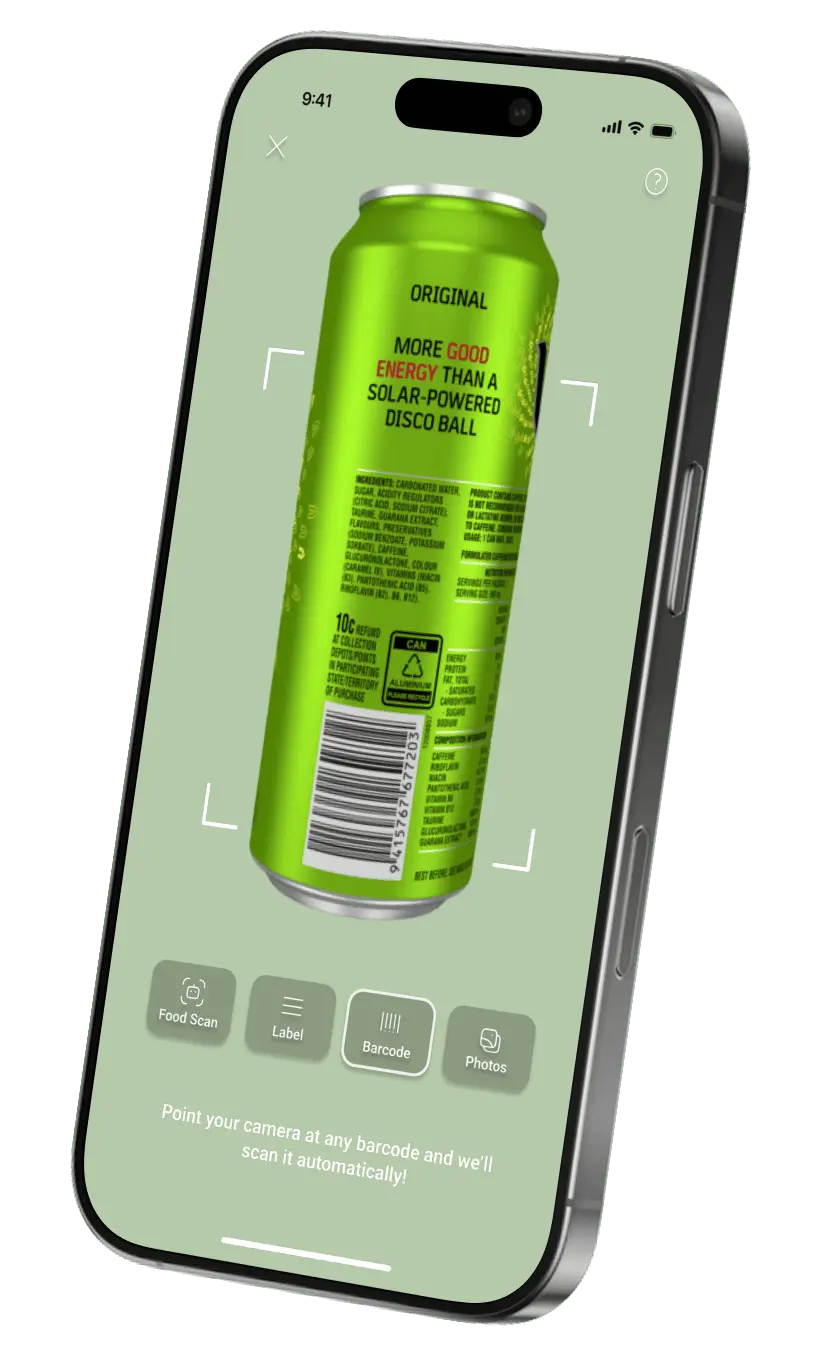
The trap is that the colours describe nutrients, not calories. A bag of nuts can show two ambers and a red for fat while being a perfectly reasonable food, and a fat-free jelly pot can show all greens while doing nothing for your hunger. Use the colours for saturated fat and salt, and read the kcal number for energy. If you are scanning barcodes into an app, you get the kcal figure straight off the pack without doing any of the maths.
British meal patterns, adjusted rather than banned
Most UK weight-loss advice quietly assumes you eat like a food blogger. You do not. You eat a meal deal at your desk, a curry on Friday, a roast on Sunday. Here is what those actually cost and what a lighter version looks like, using CoFID values against typical portions.
| Meal | Usual | Adjusted | Saves |
|---|---|---|---|
| Full English | ~1,120 kcal | ~730 kcal | ~390 kcal |
| Meal deal lunch | ~660 kcal | ~350 kcal | ~310 kcal |
| Curry takeaway | ~1,270 kcal | ~780 kcal | ~490 kcal |
| Fish and chips | ~1,240 kcal | ~860 kcal | ~380 kcal |
| Chinese takeaway | ~1,070 kcal | ~780 kcal | ~290 kcal |
| Sunday roast | ~730 kcal | ~540 kcal | ~190 kcal |
The full English
The usual plate — two grilled back bacon rashers (287 kcal/100 g), two pork sausages (294 kcal/100 g), two eggs fried in oil (200 kcal/100 g), a slice of black pudding (297 kcal/100 g), fried mushrooms (106 kcal/100 g), grilled tomatoes, beans and two slices of white toast — lands near 1,120 kcal before butter.
Now change four things, not seven. Trim the bacon fat and grill it (214 kcal/100 g). Use reduced-fat sausages (160 kcal/100 g grilled, versus 294). Poach the eggs instead of frying (149 versus 200 kcal/100 g). Dry-grill the mushrooms rather than frying them in oil (raw mushrooms are 7 kcal/100 g; frying takes them to 106). Keep the beans, keep the tomatoes, switch the toast to wholemeal. That plate is around 730 kcal and does not feel like a diet breakfast.
The meal deal
Sandwich choice is worth more than anything else in the fridge. On white bread, CoFID lists cheddar and pickle at 282 kcal per 100 g, egg mayonnaise at 243, tuna mayonnaise at 237, BLT at 230, chicken salad at 172 and ham salad at 163. On a typical 190 g sandwich, that is roughly 536 kcal for the cheddar and pickle against 327 kcal for the chicken salad. Add a 25 g bag of crisps at 493 kcal per 100 g — about 123 kcal — and the usual meal deal is around 660 kcal. Chicken salad sandwich plus a 100 g handful of strawberries is nearer 350. Nothing was banned; one sandwich was swapped.
The curry
Retail chicken tikka masala is 156 kcal per 100 g, so a 350 g takeaway portion is around 546 kcal — not the villain people assume. The accompaniments are. Retail naan is 285 kcal per 100 g, so a 160 g naan is roughly 456 kcal on its own. Pilau rice is 134 kcal per 100 g against 117 for boiled basmati, which is a smaller gap than you would think at 200 g — about 34 kcal. So: keep the curry, drop the naan, use plain rice, and order one portion of curry rather than two dishes plus sides. That is the ~490 kcal in the table, and 456 of it came from the bread.
Fish and chips
Takeaway cod in batter is 240 kcal per 100 g and chip-shop chips are 214 kcal per 100 g. A large cod at 250 g plus a large chips at 300 g is about 1,240 kcal. A regular cod, a small chips (or sharing a large), and a scoop of peas gets you nearer 860. If you eat the fish and leave some of the batter, you cut more again — the batter is where the frying oil sits.
The Chinese
Battered sweet and sour pork from a takeaway is 240 kcal per 100 g; sweet and sour chicken (not battered) is 194. Takeaway egg fried rice is 186 kcal per 100 g against 117 for boiled basmati. On 250 g portions of each, that pair of swaps is roughly 290 kcal, and the meal still tastes like a Chinese.
The pub meal and the Sunday roast
A roast is not the problem people think. Lean roasted topside is 175 kcal per 100 g, and the same joint with the fat left on is 222. Roast potatoes are 161 kcal per 100 g, a homemade Yorkshire pudding 197, and boiled carrots, peas and broccoli sit between 28 and 70. A generous plate is around 730 kcal; trimming the fat, halving the roast potatoes and doubling the veg brings it to about 540 and you keep the Yorkshire.
Drinks are the honest blind spot. Standard lager is 24 kcal per 100 ml, so a pint is around 136 kcal; premium lager is 29 kcal per 100 ml, or about 165 kcal a pint. Dry white wine is 75 kcal per 100 ml, so a 175 ml glass is around 131 kcal. Three pints on a Friday is most of a meal, and it is the single most commonly untracked thing in British diets.
Stones, pounds and kilos: what to actually expect
UK readers think in stones and pounds and get weighed in kilograms, so here is both. A 600 kcal daily deficit works out at roughly 1–2 lb (0.5–1 kg) a week for most people. That is:
- Half a stone — 7 lb, or 3.2 kg — in about six to seven weeks
- One stone — 14 lb, or 6.4 kg — in about three months
- Two stone — 28 lb, or 12.7 kg — in roughly six months
Those are averages, and progress is never linear. Weight swings by 1–2 kg across a week from water, salt, glycogen and menstrual cycle alone, which is why weighing yourself once a week at the same time — Monday morning, before breakfast — is far more informative than daily readings. If you want a reference point for whether you are in a healthy range at all, the NHS BMI calculator is free and takes ten seconds, with the usual caveat that BMI is a population screening tool and says nothing about an individual's muscle mass.
Know what's actually on your plate
Photo scanning, barcode scanning, macros and meal plans. 100% free, no subscription, no paywall on core features.
Download CalFix FreeA realistic weekly shop
You do not need a specialist retailer for any of this. Own-brand versions in Aldi and Tesco are nutritionally the same food as the branded ones, and for the staples on this list the price gap is large. A basket that covers the whole article:
- Cupboard: 1 kg rolled porridge oats, 4 tins baked beans (reduced salt and sugar if you can), 2 tins mackerel or sardines, 2 tins tuna in brine, 1 tin kidney beans, 1 bag red split lentils, wholemeal loaf
- Fridge: chicken breasts or turkey mince, a dozen eggs, reduced-fat cottage cheese, a large tub of plain natural or Greek style yoghurt, semi-skimmed milk
- Freezer: frozen peas, frozen mixed veg, frozen berries (cheaper than fresh out of season and nutritionally comparable), a bag of Quorn pieces or mince
- Fresh: baking potatoes, broccoli, carrots, onions, whatever salad you will actually eat, and British berries when they are in season and cheap
M&S and Sainsbury's are worth it for the ready meals if that is what stops you ordering a takeaway on a Tuesday — but check the front-of-pack kcal figure rather than the "balanced" branding on the sleeve. Two ready meals in the same range can differ by 300 calories.
Where tracking earns its place
You do not have to count calories to lose weight. Plenty of people do fine by fixing breakfast, fixing lunch and drinking less. But if you have tried the general advice and it has not moved, tracking is the thing that turns a guess into a number — and the usual finding is not that the food was bad, it is that the portions were 40% bigger than assumed, or that the oil, the butter on the toast, the milk in six teas and the two pints never got counted.
The catch is that manual logging is tedious, and most trackers put the useful parts behind a subscription. CalFix is 100% free with no paywall on core features: photo scanning, barcode scanning, macro tracking, weight tracking and meal plans are all included, with no subscription required. The AI is approximately 98% accurate on common foods, and where it is off — a portion of chips is a genuinely hard thing to judge from a photo — you edit the number in a couple of taps.
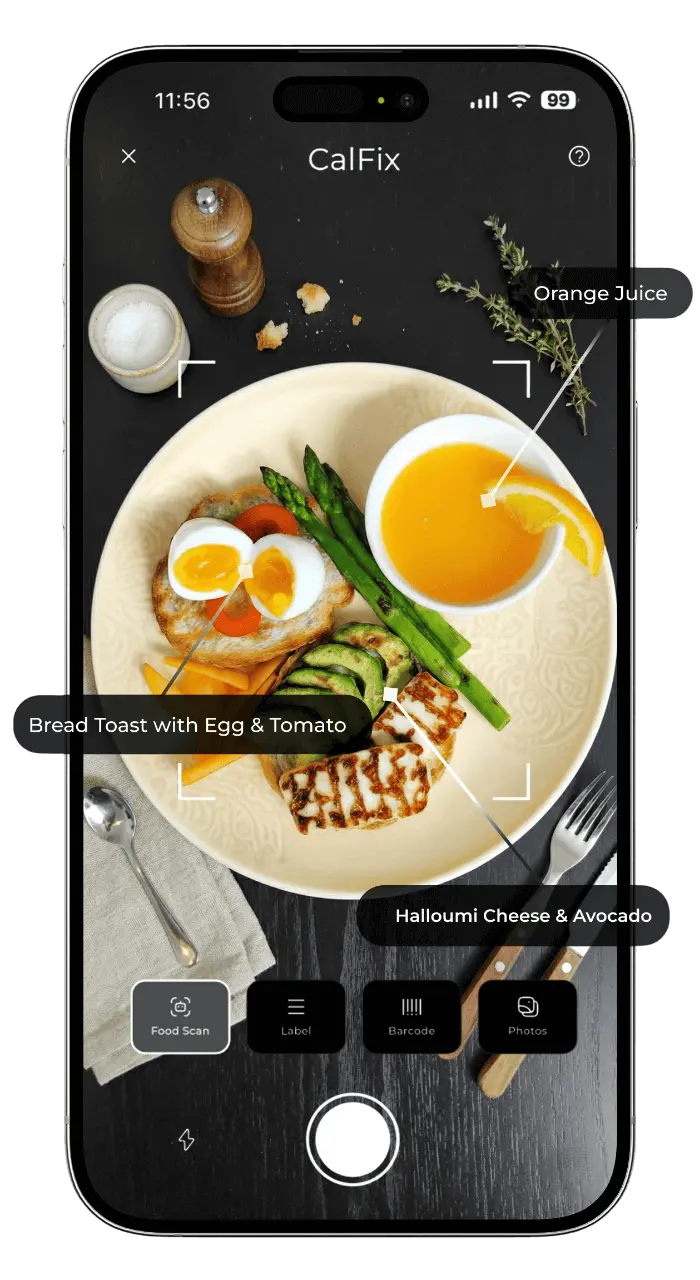
Two habits make tracking work rather than annoy you. First, weigh things for the first fortnight only — 40 g of oats, 100 g of rice, a 30 g piece of cheddar — until your eye is calibrated, then stop. Second, log the drinks. If you only ever log one thing accurately, make it the alcohol.
The honest summary
There is no British superfood. Porridge oats do not burn fat and neither does a tin of beans. What these foods do is give you more food, more protein and more fibre for the calories, which is what makes an NHS-style 600-calorie deficit something you can hold for three months instead of nine days.
If you change three things this week, make them these: put fibre in breakfast, swap the sandwich rather than skipping lunch, and count the drinks. The takeaway, the roast and the fry-up can stay exactly where they are.
If you want to see how UK guidance compares to another country's, our guide to the best foods for weight loss in Canada covers the same ground against Canada's Food Guide and the Canadian Nutrient File, and our guide to the best foods for weight loss in the USA does it against MyPlate, USDA data and American restaurant portions.
Frequently Asked Questions
What are the best foods for weight loss in the UK?
The most useful foods are the ones that are high in protein or fibre and low in calories for the volume you get. In a normal British shop that means porridge oats, baked beans, wholemeal bread, tinned mackerel and sardines, cottage cheese, natural yoghurt, jacket potatoes, frozen peas and other frozen veg, British berries, lentils and tinned pulses, chicken or turkey breast, Quorn, and eggs. No single food causes weight loss on its own. These foods simply make a calorie deficit easier to hold because they fill you up for fewer calories.
How many calories a day should I eat to lose weight in the UK?
The NHS uses a general reference of around 2,000 calories a day for women and 2,500 for men to maintain weight, and suggests reducing your intake by around 600 calories a day to lose weight in a way it describes as safe and sustainable. For many people that works out at roughly 1,400 or 1,900 calories a day. These are population averages, not a personal prescription — your own requirement depends on your size, age and how active you are. If you have a medical condition, are pregnant, or are taking medication, speak to your GP or a registered dietitian before making big changes.
Are baked beans good for weight loss?
For most people, yes. UK food-composition data lists baked beans in tomato sauce at about 81 kcal per 100 g with 5.0 g of protein and 4.9 g of fibre. Half a standard 400 g tin is therefore around 160 kcal and gives you close to 10 g of fibre, which is a third of the 30 g a day the NHS recommends. Reduced sugar and salt versions come in at about 75 kcal per 100 g. The thing worth watching on baked beans is salt rather than calories.
Can I still have a takeaway or a full English and lose weight?
Yes. Weight change follows your overall calorie balance across the week, not any single meal. A grilled full English — trimmed back bacon, reduced-fat sausages, poached rather than fried eggs, grilled tomatoes and mushrooms, beans and wholemeal toast — comes in around 390 calories below the fried version on typical portions. With a curry, the naan and the portion size matter far more than the curry itself: a 160 g naan is roughly 456 calories before you have touched the rice.
Do I need to pay for an app to count calories in the UK?
No. CalFix is 100% free with no paywall for core features. AI photo scanning, a barcode scanner for packaged food, macro tracking, meal plans and weight tracking are all included, and no subscription is required. Its AI is approximately 98% accurate on common foods, and you can correct any estimate by hand when a portion looks off.
Related Reading
Best Foods for Weight Loss in Canada
The same guide built on Canada's Food Guide and Canadian Nutrient File data.
Best Free AI Calorie Tracker Apps 2026
How the AI photo trackers compare, and what each one costs.
Calorie Tracker Without a Subscription
Which trackers are actually free versus free-until-day-seven.